Uncovering Roman Carlisle, 21 October 2024
Nick Henderson and Anna Giecco.
Nick prefaced the talk by explaining that they had already passed on information about their team’s discoveries to over 1,200 people. He then asked the audience if anyone had volunteered to work at or had visited the site, i.e. the remains of Carlisle’s Roman Bath House, now a joint project between Wardell Armstrong, Tullie House, Cumberland Council and Carlisle Cricket Club.
In Roman times there were at least 10,000 soldiers stationed on Hadrian’s Wall and Carlisle was the only city situated on it. There were two forts, one to the east and one to the south, to protect the city. In 2017, Carlisle Cricket Club pavilion was badly flooded and the club decided to relocate it to higher ground. It was whilst digging the foundations for the new pavilion that amazing discoveries began to appear. First of all, a stone with a dedication to the empress Julia Donna, dated 210AD, and a series of tile stacks which were used in the underfloor heating system of a Roman bath house. There was also a direct connection to the imperial families around the Severan Dynasty who came to power in 193AD.
An excavation project was then launched in 2019. This was delayed by Covid-19 but was restarted as a community project in 2021. One aim was to deliver community and economic benefits whilst creating activities and attractions for residents and visitors. As a consequence of the dig there have already been four major exhibitions displaying the finds. Uncovering Roman Carlisle seeks to enhance participants’ wellbeing, create a community and provide opportunities to participate in archaeology and heritage. It has so far provided over 4,000 volunteer places and 16,000 site visitors which include people from over 40 countries.
The highlights of the finds so far include the largest known building on Hadrian’s Wall which contained an inscription to Severus’s wife, empress Julia Domna (AD160–AD217) or to another Severan matriarch, also called Julia. A lump of Tyrian Purple dye was found, the most expensive colour at the time; the purple pigment was used on clothes and also for wall paintings in prestigious buildings.
Investigations first began on this site by digging three evaluation trenches. The first two revealed nothing but the third, at the northern part of the site, gave remains of a wall. By following this wall, it was discovered that the size of the bathhouse was originally over 150 feet by almost 200 feet. Underground Roman drains have also been found. One of the volunteers, who found a glass bead, commented, “This was my first ever Roman find – a piece of blue glass. It made time stop … to realise that I was the first person to touch it since someone in Roman Britain dropped it.”
Anna then showed an aerial photograph of the site with part of the underground drain exposed. Here there are signs that the drain had been rebuilt because of the type of mortar used. She estimated that this probably took place in the fourth century. In another trench was part of a mausoleum; here, evidence of cremated bodies was found. It is hoped further investigations would take place next year. Other finds in this area included large ceramic vessels, called amphorae, used to transport olive oil or wine. Some were almost intact. A large flagon which would have been used in a cremation burial was also shown. Since the dig started over 4,000 pieces of pottery have been discovered.
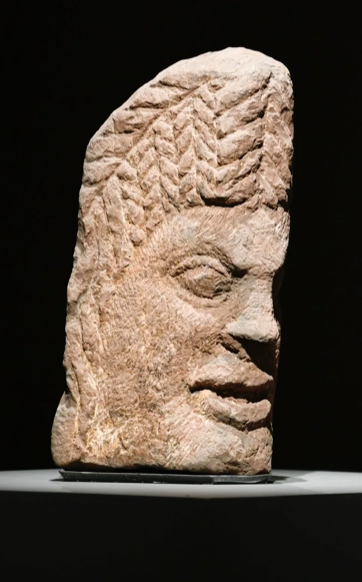
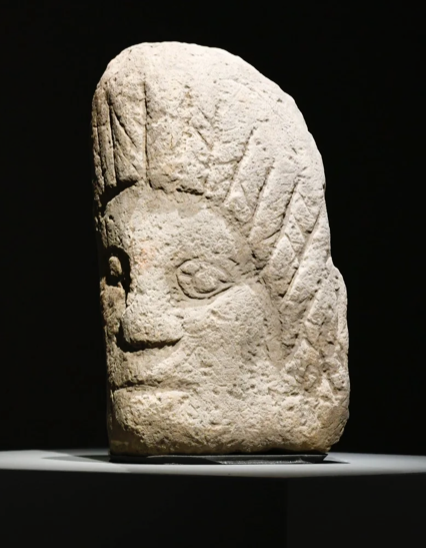
Nick and Anna went on to talk about more of the finds. Firstly, two large stone carvings of human heads were found, both over two feet tall (see the photos by Stuart Walker from the Uncovering Roman Carlisle website https://www.uncoveringromancarlisle.co.uk). It is thought that the heads represent theatre masks and would have been placed above the theatre door looking down upon the entering audience. Similar masks had previously been discovered in York. Other stone heads include a dolphin which may have been used in a fountadouble click on it toin. Another find, a carving depicting a woman’s head, is still waiting for expert examination.
A number of discs have also been discovered which have been carved with both symbols and letters, these possibly being people’s initials. Next were two bronze brooches which had been brightly painted. A selection of gaming counters along with a dice were shown, with a selection of coins in various designs. Over 150 coins have been discovered, the largest number found from one site in Britain. The oldest coin found on the site dates from 82BC which pre-dates the Roman Empire but others are much later and dating from Napoleonic times.
Pins and needles were also found, suggesting that textile work had been in progress. This collection also included hair pins. In areas where finds could be discovered, the soil and gravel were gathered in large buckets. These buckets are emptied and examined three times before being discarded. Other finds include 74 magnificently carved intaglios, the largest collection from any single context in the UK. Intaglios are carved gemstones which would have been worn in finger rings; they had both symbolic and practical uses, the main being to impress on wax, as a seal. It is thought that Carlisle had its own school of engravers because some of the symbols discovered only appear in this area.
Nick and Anna ended their most interesting talk by describing the memories and emotions of the people who have volunteered in the past, “I remember coming up from the trench wet from the rain and covered in red mud. Seeing the print of the toes on that wet clay brought home the human side of the construction of the bathhouse.” … “I found two tiles with the IMP stamp on in a stack. They clearly showed a connection between the bathhouse and the emperor. It is amazing to find these in Carlisle.” … “After a few days of digging you learn to temper the anticipation, but my heart skipped a beat as I carefully (but not professionally) cleared away more soil and held up my find. I nervously handed it over to the supervisor who smiled broadly and said, “that’s very nice.”
For the project to continue, it also needs to ensure it maintains and builds on the support it has been given so far by a network of organisations and individuals. Certainly, our two speakers this evening conveyed enthusiasm and support for this whole enterprise. They gave us news of projects to come, inspired by present work, and fulsome explanations. The breadth and details of these were both comprehensive and inspiring.
The accompanying photographs were taken from the
Uncovering Roman Carlisle website
at https://www.uncoveringromancarlisle.co.uk.